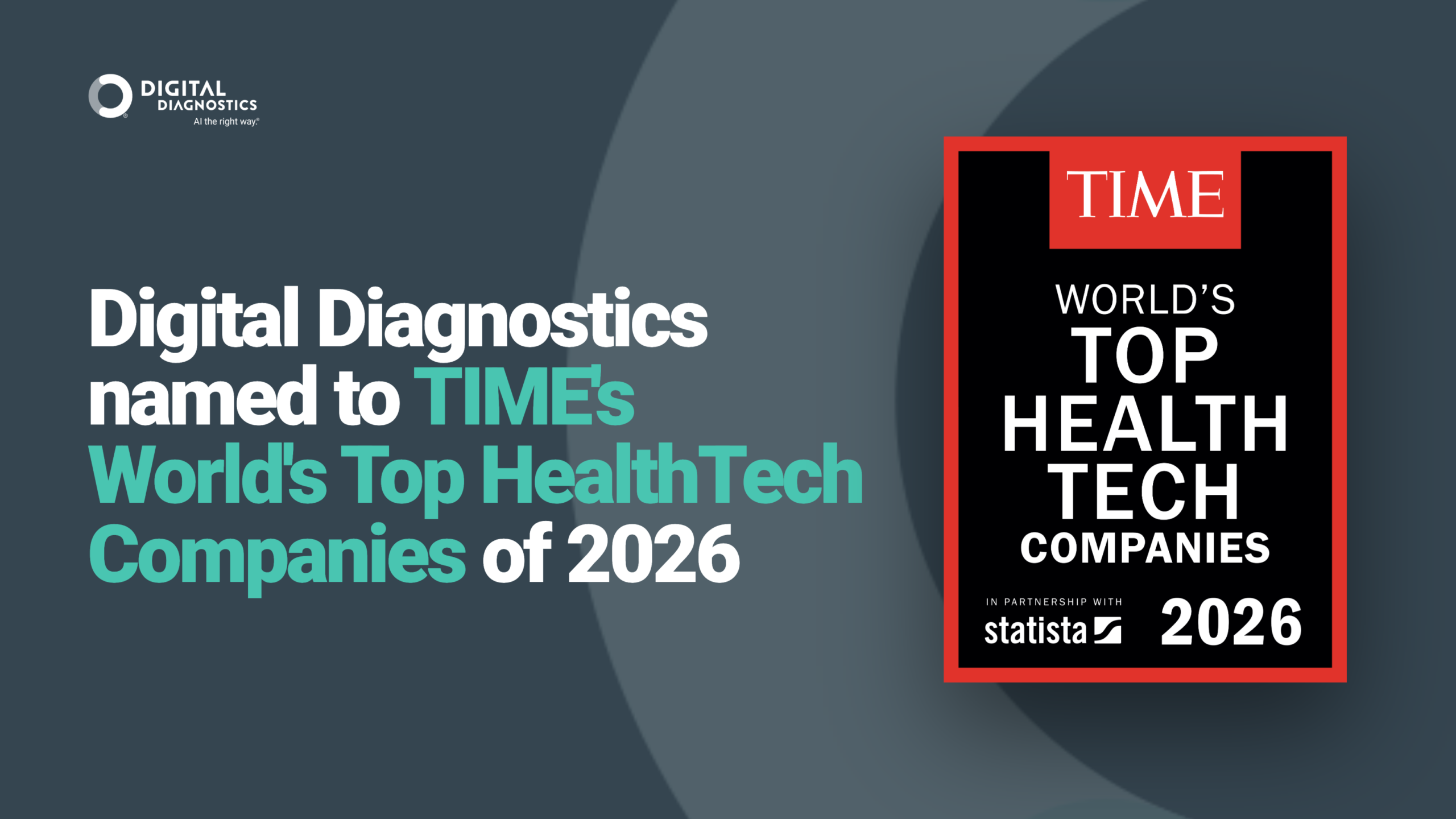
A Recognition Earned Where Care Happens
TIME’s recognition reflects a reputation built in exam rooms, one primary care visit at a time.
This month, TIME published its World’s Top HealthTech Companies of 2026, a list that evaluates thousands of companies on their financial performance, their reputation, and how the world engages with them. Digital Diagnostics is honored to be recognized among them.
Of those three measures, reputation is the one that means the most, because in healthcare it cannot be manufactured. It is built slowly, by the clinicians who trust a result, the health systems that stand behind a program, and the patients who get their diabetes eye exam during a visit they were already making, without a second trip or a second wait. This recognition belongs to them as much as to anyone at Digital Diagnostics.
A Disease That Gives No Warning
Diabetic retinopathy is the leading cause of blindness in working-age adults, and it arrives quietly.1 In its early stages it causes no pain and no change in vision, so a person can feel perfectly well, keep working, keep driving, keep reading to their children, while damage accumulates at the back of the eye. By the time sight begins to blur, the window for the simplest interventions may already be closing.
That is what makes the annual diabetes eye exam so important, and what makes the numbers so hard to accept: roughly 60 percent of adults with diabetes do not complete it.2 That gap is not about how much people care. It is about a referral to a specialist across town, time off work that cannot be spared, a ride that falls through, a second appointment that gets pushed until it is forgotten. Diabetic retinopathy is serious, and it is also preventable. The tragedy is how often the gap between those two facts comes down to logistics.
Where It Started: The Patients Who Never Arrived
Digital Diagnostics’ Founder and Executive Chairman, Michael D. Abràmoff, MD, PhD, is a retina specialist and computer scientist who sees patients in practice. The problem that shaped his work was not a technical one. It was the patients he never had the chance to meet: the people with diabetes who needed an eye exam and were never reaching an eye clinic at all.
If those patients could not get to the specialist, he reasoned, the exam would have to go to them.
“The only way to solve the problem is to be where the patient is, which is primary care, endocrinology, nephrology, diabetes clinics, and emergency departments.”3
Getting there took years. In 2010, an editorial called him “The Retinator,” a nod to the worry that a computer reading retinal images would get it wrong or push physicians aside.4 In 2018, the FDA authorized LumineticsCore® (then IDx-DR) through the De Novo pathway, the first autonomous AI diagnostic system cleared to make a diagnosis without physician input.5 With that, the diabetes eye exam moved into the primary care office, into a visit the patient was already having, with the result available before they left the room.
What Changes When the Exam Comes to the Patient
Consider what that shift means for the patient who has been putting the exam off. She is already at her primary care office for a routine diabetes visit. Instead of leaving with a referral to a specialist she may never see, a medical assistant takes images of her retinas during the appointment, and LumineticsCore delivers a diagnostic result before she leaves. No separate scheduling, no second trip, no weeks of waiting for a read. For patients in rural and underserved communities, and for anyone whose second trip to a specialist was the reason the exam never happened, this is often the difference between an exam that gets done and one that does not.
Completing the exam is only the beginning. When the diagnostic result is delivered during the primary care visit (as it is with LumineticsCore), studies show that patients are more likely to follow up than with remote reading or a standard referral,6,7 and the ones who need an ophthalmologist get there sooner.8 The result and the conversation happen in the same room, on the same day, with a clinician the patient already knows. When the result shows no disease, the patient is spared a specialist visit she did not need, which keeps that appointment open for someone who does.
The People Who Made This Possible
None of this happens without the health systems, community health centers, and primary care practices that chose to bring diabetic retinopathy testing into their own exam rooms. Adopting a new way of delivering care is never simple. It means training staff, adjusting workflows, and trusting a result that arrives in minutes rather than weeks. The clinicians and care teams who took that step, and who have kept taking it visit after visit, are the reason this technology now reaches patients who were once out of reach entirely.
The same is true of the patients. Every follow-up appointment kept, every case of diabetic retinopathy caught early, is a story that belongs first to the person who showed up for their own care. Digital Diagnostics is grateful to play a part in it.
One Primary Care Visit at a Time
A list like TIME’s measures a company at scale, but the work is carried out locally. It happens in an exam room in a community health center, when a medical assistant takes retinal images during a routine visit and a patient who has put this exam off for years gets an answer before leaving. It happens when that answer becomes a follow-up appointment that is actually kept, and when a disease that gives no warning is found while there is still time to act.
That is the reputation TIME’s list reflects: a diagnostic that clinicians rely on, that health systems can stand behind, and that reaches the patients who need diabetic retinopathy testing most.
Looking Ahead
At Digital Diagnostics, the mission has not changed since the first patient was tested in a primary care office: bring specialist-level diagnosis to where people already receive care, so that no one loses sight to a disease that could have been caught.
The company is grateful to the clinicians, health systems, and partners who have trusted it with their patients, and to a team that has carried this mission forward. The work continues, one visit at a time.
Interested in connecting with Digital Diagnostics?
Follow Us on LinkedIn Schedule a Meeting
References
- Centers for Disease Control and Prevention. Vision Loss and Diabetes. Reviewed May 15, 2024. https://www.cdc.gov/diabetes/diabetes-complications/diabetes-and-vision-loss.html
- American Academy of Ophthalmology. Sixty Percent of Americans with Diabetes Skip Annual Sight-Saving Exams. October 20, 2016. https://www.aao.org/newsroom/news-releases/detail/sixty-percent-americans-with-diabetes-skip-exams
- Hadziahmetovic M, Abràmoff MD, AlQahtani A, et al. Global DR Screening: Why Aren’t We There Yet? Retina Today. September 2026. https://retinatoday.com/articles/2026-sept/global-dr-screening-why-arent-we-there-yet
- McDonnell PJ. ‘The Retinator’: revenge of the machines. Ophthalmology Times. 2010;35(13):4.
- US Food and Drug Administration. FDA permits marketing of artificial intelligence-based device to detect certain diabetes-related eye problems. April 11, 2018. https://www.fda.gov/news-events/press-announcements/fda-permits-marketing-artificial-intelligence-based-device-detect-certain-diabetes-related-eye
- Dow ER, Chen KM, Zhao CS, et al. Artificial intelligence improves patient follow-up in a diabetic retinopathy screening program. Clin Ophthalmol. 2023;17:3323-3330. https://doi.org/10.2147/OPTH.S422513
- Knapp AN, Dow E, Chen K, et al. Real world outcomes from artificial intelligence to detect diabetic retinopathy in the primary care setting: 12 month experience. Invest Ophthalmol Vis Sci. 2023;64(8):252. https://iovs.arvojournals.org/article.aspx?articleid=2785896
- Espinoza C, Sator R, de León R, et al. Autonomous AI improves rates of annual eye exams for diabetes (EED) and reduces time-to-follow-up in a complex population. Digital Diagnostics, 2023. (Tarzana Treatment Centers case study) https://www.digitaldiagnostics.com/resources/insights/white-paper-autonomous-ai-prevents-blindness-by-increasing-eye-exam-for-diabetes-access-for-so-cal-patients/